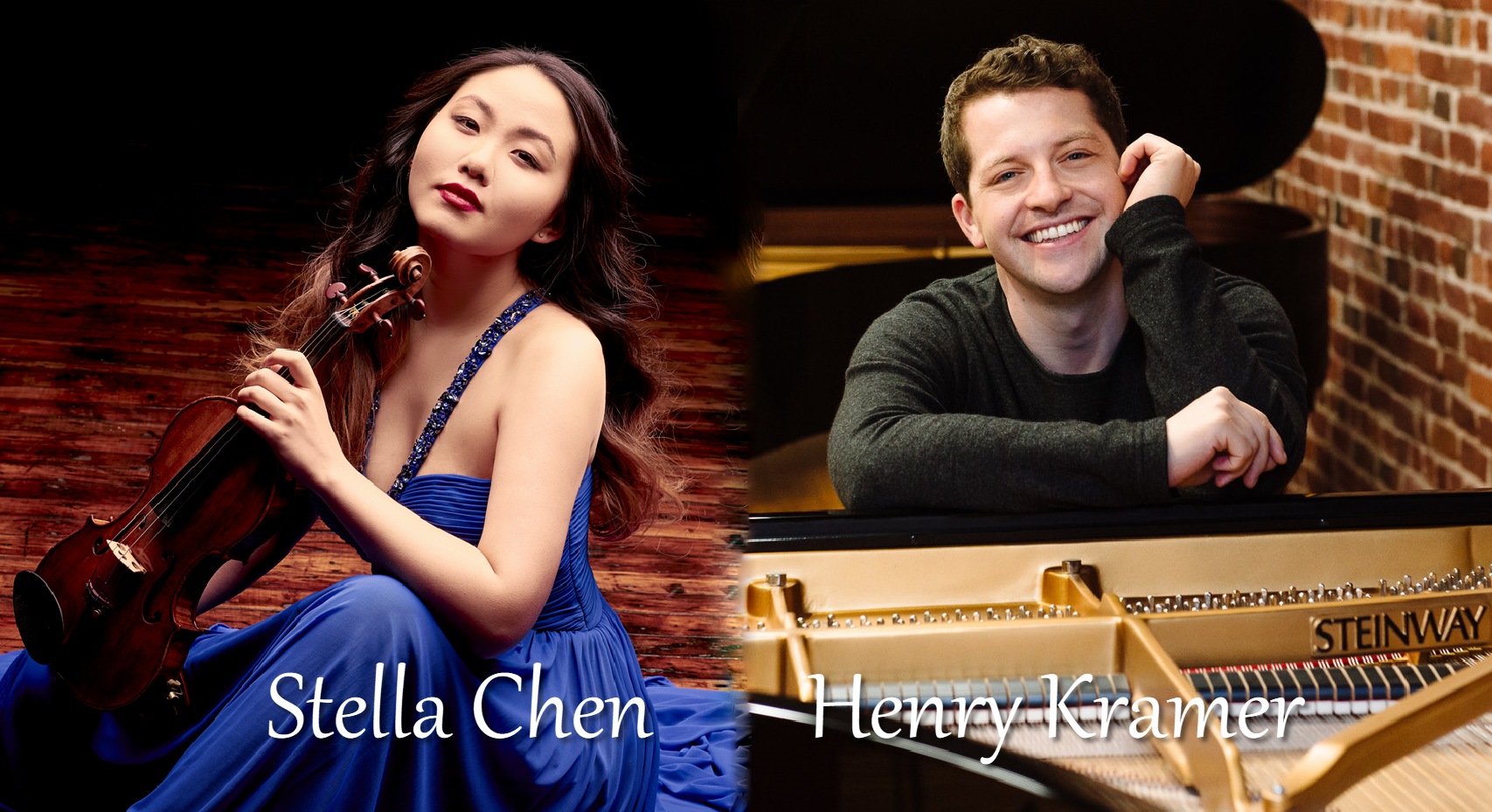
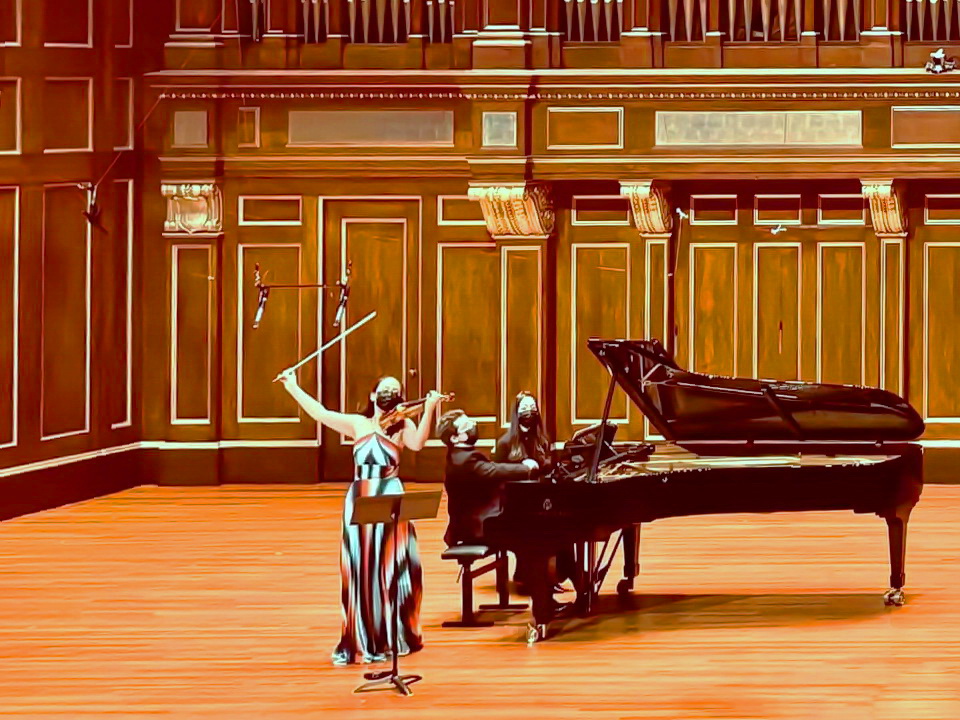
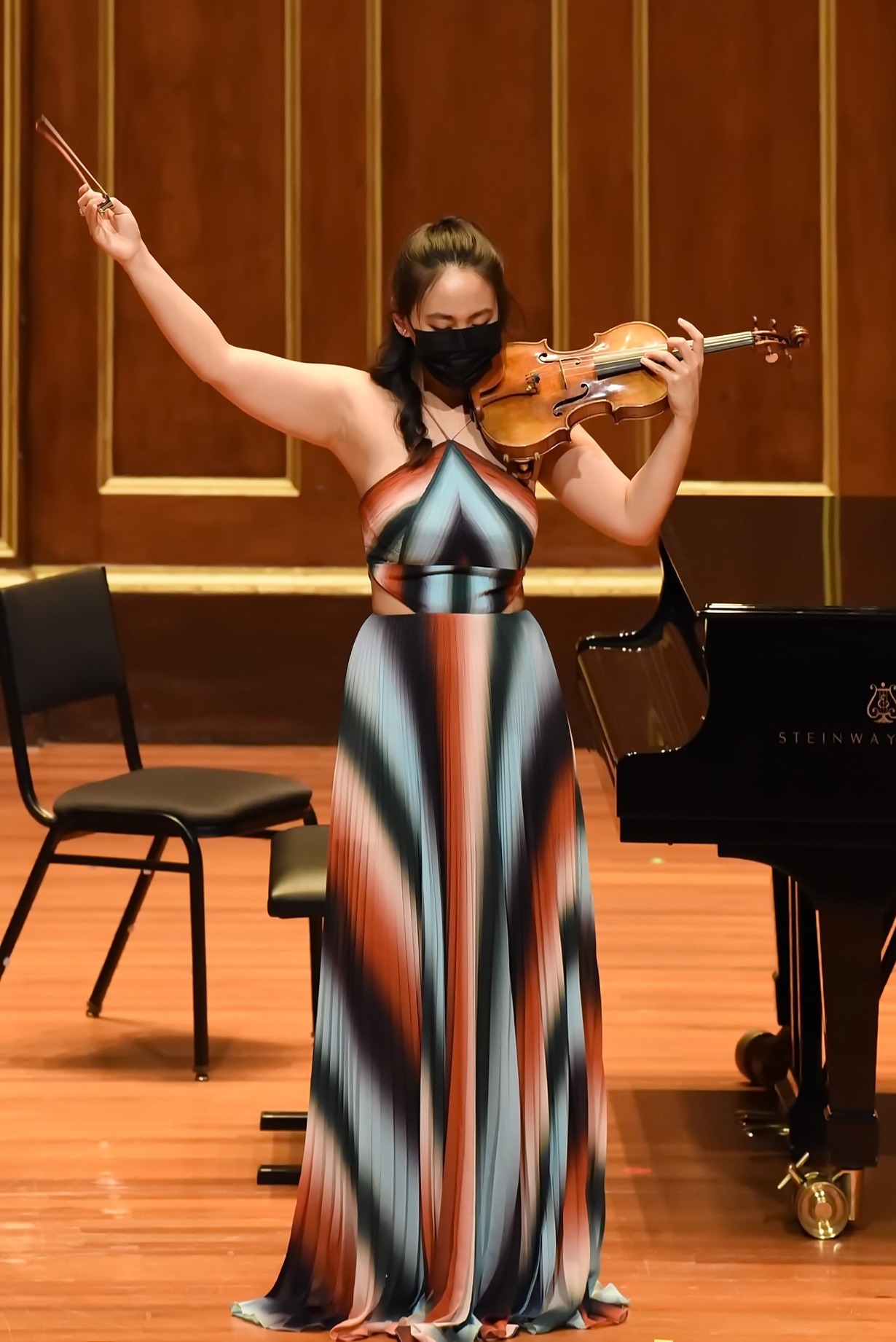
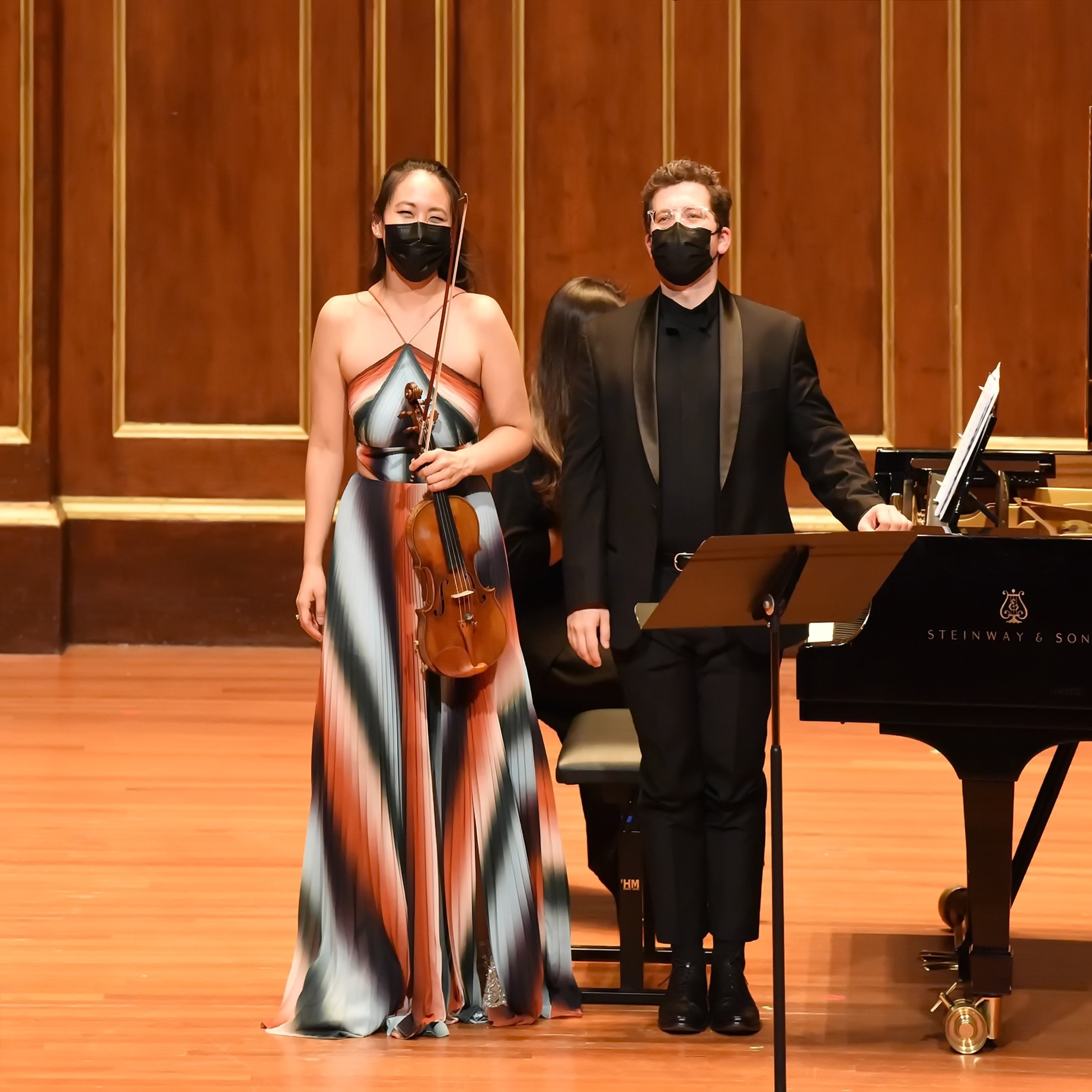
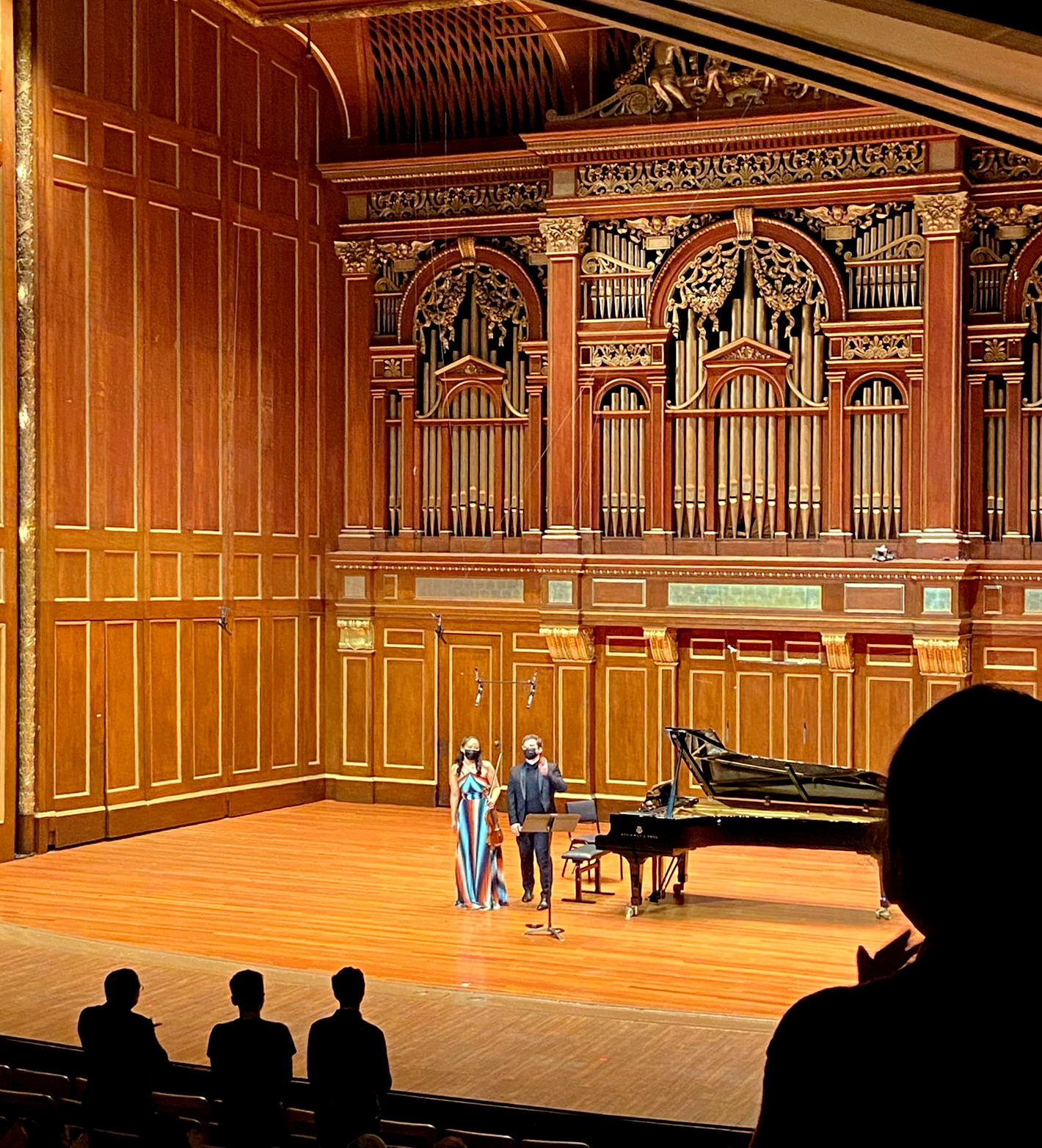
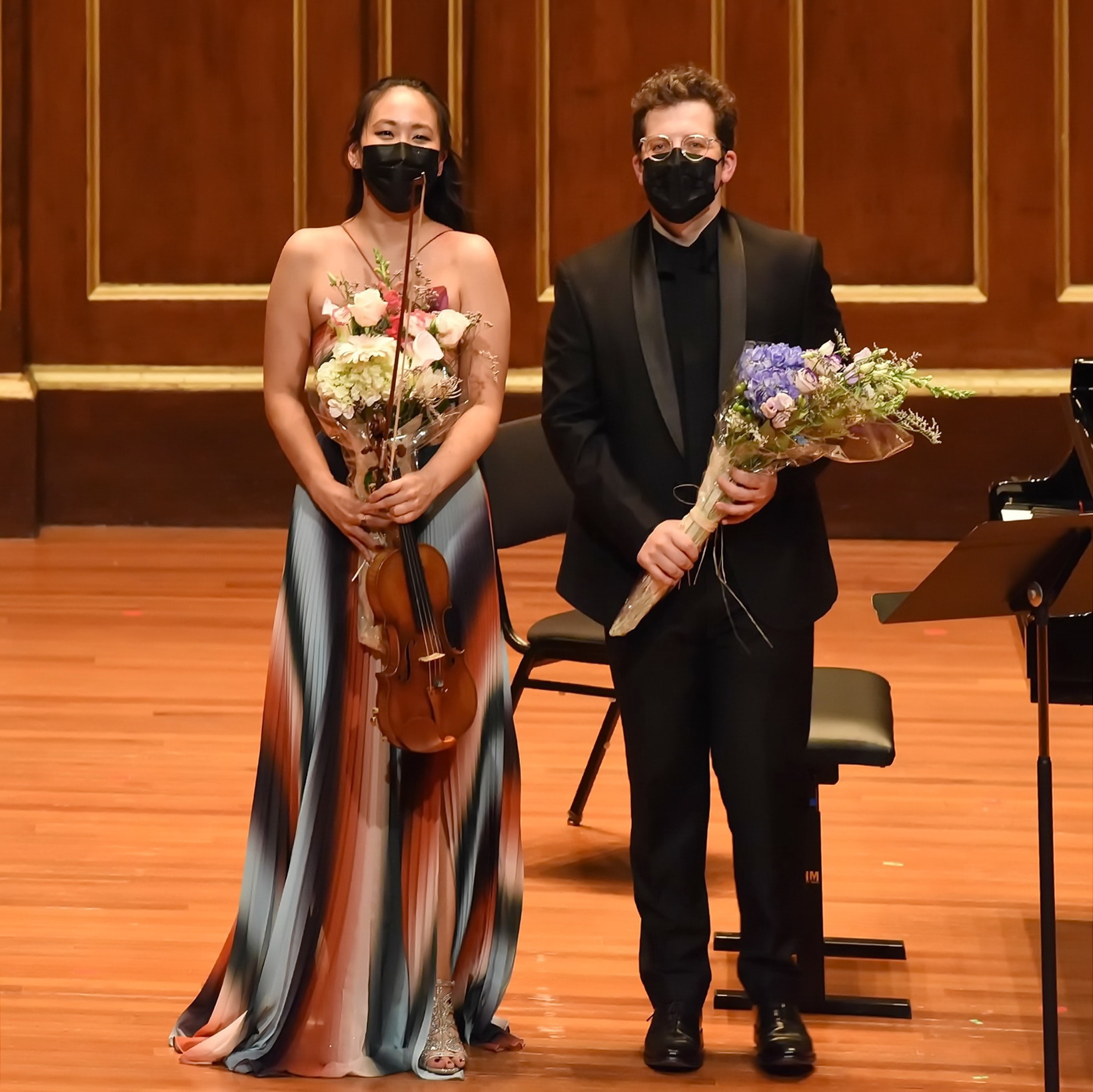
Stella Chen,
violinist
First Prize, 2019 Queen Elisabeth Competition
https://stellachen.com
 "Her performance sounded fresh and spontaneous, yet emotionally
profound and intellectually well-structured."
-The
Jerusalem Post "Her performance sounded fresh and spontaneous, yet emotionally
profound and intellectually well-structured."
-The
Jerusalem Post
"Stella Chen looks to tell a story and does it with beautiful
nuances and beautiful intentions." -Le Soir(translated from
French)
Praised for
her "phenomenal maturity" and "fresh and spontaneous, yet
emotionally profound and intellectually well-structured
performance" (Jerusalem Post), American violinist Stella
Chen garnered worldwide attention with her first-prize win
at the 2019 Queen Elizabeth International Violin Competition,
followed by the 2020 Avery Fisher Career Grant and 2020 Lincoln
Center Emerging Artist Award.
Following debuts with
the Chicago Symphony and Chamber Orchestra of Europe in summer
2021, her auspicious 2021-22 season sees her recital debut at
Carnegie Hall and recital, concerto, and chamber music
appearances throughout Europe, Asia, and North America,
including debuts with Kremerata Baltica, German State
Philharmonic, and New Japan Philharmonic, as well as appearances
with Chamber Music Society of Lincoln Center both in New York
and on tour.
Stella’s most recent engagements include appearances with the
Belgian National Orchestra, Brussels Philharmonic and the
Luxembourg Philharmonic and at the Phillips Collection in
Washington, DC, Salzburg Mozarteum, Ravinia, and Kronberg
Academy Festivals. Stella has appeared as a chamber musician in
festivals including the Perlman Music Program, Music@Menlo, the
Sarasota Festival, and YellowBarn.
She is the first recipient of the Robert Levin Award from
Harvard University, the top prize winner of the Tibor Varga
International Violin Competition and youngest ever prize winner
of the Menuhin Competition. Stella plays on the 1700 ex-Petri
Stradivarius, on generous loan from Dr. Ryuji Ueno and Rare
Violins In Consortium, Artists and Benefactors Collaborative.
2021/2022 authorized by
artist management.
Henry Kramer,
pianist
http://www.henrykramerpiano.com
 "…a
pianist of enormous talent…[he] personalized interpretations to
such a degree that works emerged anew. He is a big personality." "…a
pianist of enormous talent…[he] personalized interpretations to
such a degree that works emerged anew. He is a big personality."
—
PETER DOBRIN, PHILADELPHIA INQUIRER
The winner of the Second Prize at the 2016 Queen Elisabeth
Competition and a recipient of a 2019 Avery Fisher Career Grant,
pianist Henry Kramer is establishing himself as one of the most
exciting American musicians of his generation. His performances
have been praised by critics as "triumphant" and "thrilling"
(The New York Times), and "technically effortless" (La Presse,
Montreal).
Henry has been invited to play with orchestras across the globe
including the National Belgian Orchestra, Brussels Philharmonic,
Calgary Philharmonic, Shanghai Philharmonic, Bilkent Symphony
Orchestra in Ankara, Turkey, the Portland (Maine) Symphony
Orchestra, the Orchestre Métropolitain du Montreal, and the Yale
Philharmonia. He has soloed under the batons of preeminent
conductors Marin Alsop, Jan Pascal Tortelier, and Stéphane
Dénève.
Henry holds both a Master’s and a Bachelor’s degree from The
Juilliard School, where he received the 2015 William Petschek
Recital Debut Award, and an Artist Diploma from the Yale School
of Music, where he received the Charles S. Miller Prize for the
most outstanding first-year pianist. In 2018, he earned his
Doctorate of Musical Arts from the Yale School of Music.
Dr. Kramer currently holds the L. Rexford Whiddon Distinguished
Chair in Piano at the Schwob School of Music at Columbus State
University in Columbus, Georgia.
|
|
 
NOTES ON THE PROGRAM
By Dr. Jannie Burdeti
Copyright©1999-2021
Foundation for Chinese Performing Arts
Béla Bartók
(1881-1945)
Sonata for Solo Violin Sz. 117, BB 124
Tempo di ciaccona
Fuga: Risoluto, non troppo vivo
Melodia: Adagio
Presto
(28')
Yehudi Menuhin received the manuscript of Bartók’s Sonata for
solo violin in March 1944 at the age of twenty-seven. He later
wrote, "Little did I foresee that he would write me one of the
masterpieces of all time. . . . I admit I was shaken. It seemed
to me almost unplayable." However, after a few months of study,
the celebrated violinist revised his initial view: "The Solo
Sonata is eminently playable, beautifully composed for the
violin, one of the most dramatic and fulfilling works that I
know of, [and the] most important composition for violin alone
since Bach." A decade prior, the young Menuhin had been the
first violinist in history to undertake the monumental task of
recording the complete set of Partitas and Sonatas for solo
violin by Bach. Moreover, one of the first pieces that Bartók
heard Menuhin perform live was Bach’s unaccompanied Sonata in C
Major. Perhaps inspired by the violinist’s playing, when he was
approached by Menuhin for a commission—"not hoping for a third
concerto, just a work for violin alone"—Bartók modeled his solo
sonata on Bach’s solo violin works, which follow the structure
of Italian church sonatas (sonata da chiesa): a slow
introduction followed by a fugue, a lyrical slow movement, and a
fast finale.
Bartók’s first movement, titled Tempo di ciaccona,
makes use of the pacing of the chaconne genre, the gravitational
tendency toward the second beat, and a similar eight-bar phrase
construction. In addition, Bartók would no doubt have also had
in his mind’s ear the Sonata in B Minor for solo cello, by his
friend and fellow Hungarian Zoltán Kodály, written a few decades
earlier, which opens with a similar panache. Not unlike Kodály’s
work, Bartók’s Tempo di ciaccona requires the performer
to be almost constantly playing double, triple, or quadruple
stops.
The steely fugal movement opens with an austere subject
punctuated by silences. Menuhin remarked that he found this to
be the most brutal music he ever encountered. It is a four-voice
fugue, and although its exposition proceeds as expected, the
voices soon converse freely. Musicologist Halsey Stevens
describes it as a "fugal fantasy."
The third movement, Melodia, features music that
Bartók had jotted down in his "Arab field book." It begins with
a haunting chromatic melody. As is characteristic of many of his
slow movements, Bartók features "night music," evoking the
colorful sounds of nature after sunset.
In the original manuscript of the final movement, Bartók notates
quarter tones (smaller subdivisions of the scale than the
twelve-note Western system), illustrated by arrows. Menuhin
writes: "[He] gave me the option of playing these passages in
half tones [as in the Western scale], and given that I had only
weeks to prepare the Sonata, I found the demand of accurate
quarter tones in fast tempo too intimidating and chose his
alternative." Today, both versions are performed. Elements from
previous movements peek through the frenzy of constant sixteenth
notes. After the whirlwind, the sonata finishes fearlessly on a
triumphant G-major chord.
Not unlike Mozart and Schubert, Bartók, despite his fame, faced
great financial troubles during the final years of his life. He
wrote to his son Péter: "Here am I with my ‘world-fame,’ and in
such misery. Of course, one can not fill one’s
stomach with world-fame!" To avoid the Nazis in Hungary, Bartók
moved to the United States in 1940 as a political exile. The
last five years of his life, from 1940 to 1945, were fraught
with difficulties finding performances and paying bills, as well
as ill health that prevented him from composing, all while
doctors struggled to diagnose and treat his leukemia. His last
works included his Solo Violin Sonata, Third Piano Concerto,
Concerto for Orchestra, and a sketch of his Viola Concerto.
Franz Schubert
(1797-1828)
"Ständchen" from Schwanengesang, D. 957, No. 4
(arr. Mischa
Elman)
Written during the last months of the composer’s
brief life of thirty-one years, Ständchen remains one of
Schubert’s most well-loved songs, composed for voice and piano.
Tobias Haslinger published it after Schubert’s death as the
fourth piece of his song cycle Schwanengesang (Swan
Song). Written by poet and music critic Ludwig Rellstab, the
poetry exudes the passionate yearning of a lover for the
beloved. It begins, "Softly my songs plead / through the night
to you; / down into the silent grove, / beloved, come to me!"
Franz Schubert
(1797-1828)
Sei mir gegrüßt, D. 741
(arr. by Stella Chen)
Not unlike Ständchen in both its meter and piano
accompaniment, Sei mir gegrüßt (I greet you) appeared a
few years earlier, in 1822. The poet was Friedrich Rückert, who
with his poetry inspired not only Schubert but also Robert and
Clara Schumann, Brahms, Mahler, Richard Strauss, Bartók, and
many others. Rückert was fluent in thirty languages, and his
translations of Asian poetry are widely celebrated.
Sei mir gegrüßt
conveys the ecstasy of love with such surges of emotion as "You
who were torn from me and my kisses, / I greet you! / I kiss
you! . . . One breath of love dissolves time and space, / and I
am with you, / you are with me; / I hold you closely in my arms’
embrace, / I greet you! / I kiss you!"
Eleanor Alberga
(1949-)
No-Man’s-Land Lullaby
(11')
Born in Kingston, Jamaica, in 1949, Eleanor Alberga decided at
the early age of five, when she began lessons, that she would
become a concert pianist. In her words, at twelve, she suddenly
fell madly in love with the music of Bartók, who holds a
powerful influence on her to this day. Her strongest musical
influences include the tonality and rhythms of her native
Caribbean heritage, as well as contemporary European music, and
she finds much inspiration in her dreams, in nature, and in
dance. Alberga lives in the UK with her husband, violinist
Thomas Bowes.
Of her work No-Man’s-Land Lullaby, she writes:
"Setting about writing a new work for violin and piano in the
summer of 1996, I had planned a somewhat lightweight and
predominately up-beat piece. However, I was to receive
visitations which ensured that the piece which emerged as No-Man’s-Land
Lullaby has neither of these qualities. Indeed, for me the work
became a kind of acknowledgement of European-ness and a
realization that her two World Wars were part of my heritage
also.
"Visiting parts of Europe over that summer of 1996 I was struck
by the almost unreal beauty of the landscapes, yet I received a
heavy sadness in the atmosphere that took me back to the events
of half a century ago, some of which had been played out against
this very scenery. At the same time I was visited by a melody.
It arrived unbidden and would not leave me alone. It seemed
however, to offer comfort.
"It was the imagery of the First World War that seemed finally
to bring these things together, especially the image of men
dying slowly and uncomforted in a place called No-Man’s-Land.
The piece is cast in three sections and is entirely based on the
melody that emerges most identifiably towards the end."
The melody that is revealed near the end hints at Brahms’s
famous Wiegenlied (Lullaby). An alternate title of this
piece appears on Alberga’s website as "No Man’s Medley."
Richard Strauss
(1864-1949)
Violin Sonata in E-flat Major, Op. 18
Allegro, ma non troppo
Improvisation: Andante cantabile
Finale: Andante — Allegro
(28')
Under the tutelage of his father, Franz—a French horn player so
accomplished that he was dubbed the
"Joachim
of the horn"—Richard Strauss was nourished on the music of the
classical masters: Haydn, Mozart, and Beethoven. He began
learning the piano at three years old and violin at eight.
Written in 1887 and preceded by Op. 5 and Op. 6 (a piano and
cello sonata, respectively), Richard Strauss’s Violin Sonata
marks the last of his early instrumental works and an end to his
use of classical forms.
During the conception of his violin sonata, Strauss perfected
his mastery of orchestral writing, and indeed, this sonata
boasts epic proportions, breadth, and an intoxicating intensity
of Romantic fervor, evoking the full spectrum of symphonic
colors. Significant influences may have been his extensive
exposure to orchestral music during this time period: he joined
his father’s amateur orchestra as a violinist in 1882, trained
with Hans von Bülow in the rival schools of Brahms and Wagner
(which was considered quite unusual), and held the position as
the third conductor in the Munich Court Opera between 1886-1889.
The nature of his extremely Romantic writing during this period
is also said to result from his love for Pauline de Ahna, his
wife-to-be.
The first movement of the sonata opens with a heroic gesture,
reminiscent of a brass section. Its energetic rhythmic motive
returns in various guises in a "truly symphonic treatment either
in Lisztian unison, declamatory phrases, cumulative imitation,
or through the tension of ostinato," as noted by Norman Del Mar.
The music is filled with moments of great tenderness and
intimacy, as well as an abundance of melodic material. The
second theme is a soaring melody that spans two and a half
octaves. Soon after, the development reestablishes the obsessive
rhythmic element first heard in the beginning.
Steeped in lyrical elegance, the central movement,
"Improvisation," opens like a song without words. A stormy
section follows, quoting Schubert’s Erlking and later
dissolving into a reprise of the opening melody. Del Mar writes
that, despite its ABA form, the moniker of "improvisation" stems
from its middle section, after the storm, "in the sudden
disintegration . . . into an infinitely delicate lace-work of
rapid Chopinesque figures." The coda sneaks in a hidden quote
from the Adagio of Beethoven’s
Pathétique Sonata.
After a foreboding and somber piano introduction, where Strauss
anticipates the principal theme of the ensuing Allegro, the
finale makes a return to the bravura character of the first
movement, calling to mind his tone poem Don Juan. He
includes a reference to Wagner’s Tristan und Isolde amid
the rapidly rising figures. Following the vigorous and
adventurous development section, a tremendous flourish for the
piano heralds the recapitulation. The completion of this violin
sonata of symphonic scope was a stepping stone for Strauss, as
he would for the next years turn his attention toward the
symphonic tone poem.
Copyright©1999-2021
Foundation for Chinese Performing Arts
|